


from Addicted to Stamps and More! http://bit.ly/2KX8ed1


Are you tired of writing blog posts for tiny money? If you want to earn money blogging — real money — this post is for you.
There are several ways I’ve been well-paid for blog writing.
And today, I thought I’d run down three great ways to leave terrible, $5-$25 blog post pay behind.
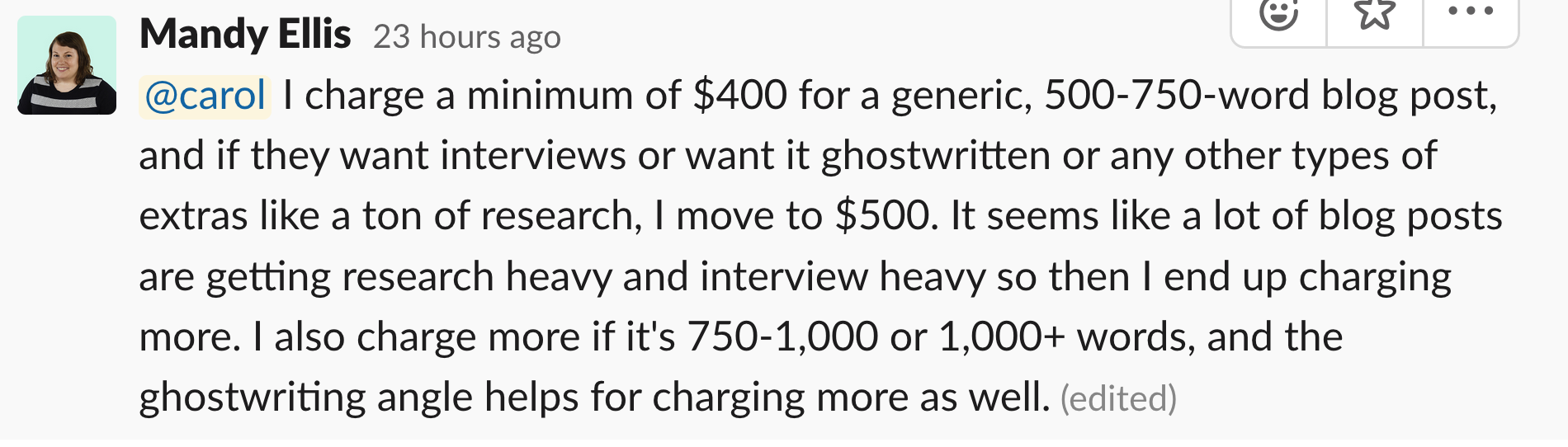
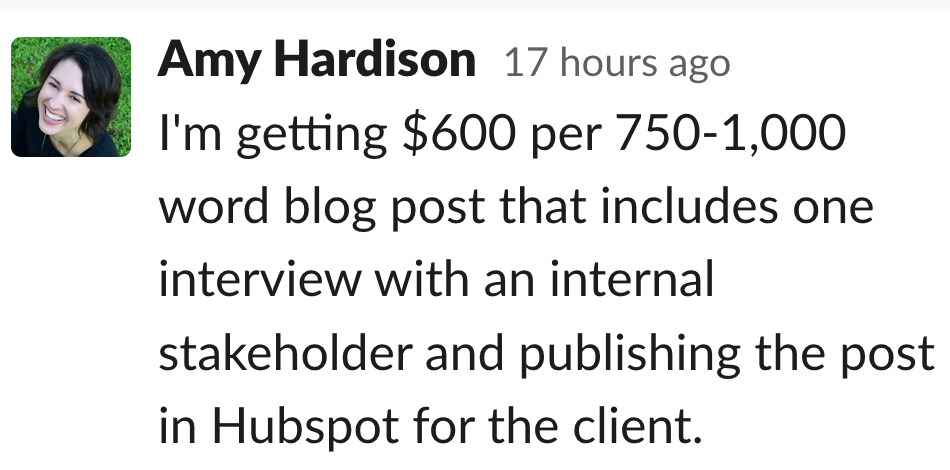
What does it look like, to get paid $500 per blog post?
How does that happen?
All my tips are below.
I’ve been earning well writing blog posts for a long time, and there’s never been more opportunity for bloggers to make serious money.
We’re going to begin with the biggest obstacle to being well-paid for blog-post writing.
It’s not content mills, or Upwork, or Craigslist ads.
It’s between your ears.
The top problem I see with low-paid bloggers is that they don’t believe there is professional-rate pay for writing blog posts. I get emails all the time, accusing me of making it up.
If you’ve been making $30 per post for years, it may be hard to buy. But while you were slaving, trying to crank out two blog posts per hour, 9 or 10 hours per day, to make a decent wage…others got $300, $500 and even more for a single post.
You have to believe good pay is out there for blog-post writing. Not just for me, but for lots of writers. If you don’t believe it’s real, you won’t pursue it.
Maybe this will help: I asked my coaching grads who earn $500 and up per blog post to weigh in. Here are a couple responses:
Once you understand that this is real, it should unleash your hunger to earn money blogging for real.
Now that I’ve opened your mind, here are the three basic ways to grow your blog-writing income:
It’s probably not a surprise to learn that most of the higher pay in blogging comes from writing longer posts for deep-pocketed clients. There aren’t a lot of $500 assignments to write 350-word posts.
Makes sense, right?
Most of the $500+ blog-post writing gigs floating around are for posts of 1,000 words and up. Many are for 1,500-2,000-word posts.
If you’ve never written longform, try to find an opportunity to get some samples into your portfolio. Start learning how to outline and execute blog posts that have multiple sections.
Business blog editors are craving ultimate guides, long resource lists, and other lengthy, authoritative content. Why? Because Google rewards it in search. A long, detailed post can be a great way to rank well for your chosen search phrase.
These are the sort of blog posts that are more like articles. There may be research or interviews involved. They make great portfolio clips, and they pay well.
This leads to the next big question. Who can afford to commission long, $500 posts? Not your typical internet startup solopreneur who’s working from his couch and advertising on Problogger, or some such.
In freelance blogging, there’s a basic truth: Bigger companies have bigger budgets, and more regular, ongoing blogging work.
This is the type of client that commissions $500 blog posts. They do that because they understand the power of content marketing to drive more sales in their business.
A few bullets to flesh out this ideal-client avatar. Target clients for big-money blog post assignments:
If you’re earning tiny paychecks per blog post, this probably isn’t a description of your current clients.
And yes, I know — pitching up the ladder to real companies scares the crap out of you.
Can I help you get over that? Because many of these mid-sized and larger companies are hungry-hungry for blogging help. They’re deep into content marketing and wish they had the time to find more talent.
Shoot them a pitch, lather, rinse, repeat. If you’ve blogged for small biz, you’re ready to move up. The biggest reason you’re not earning more is that you’re simply not going after better clients.
Want to make it easy to get hired for the top-paid blogging assignments? Then you need a track record.
You need to show how your blog posts connect the business to more money. The more companies can connect the dots and see your content leads to more opt-ins and, ultimately, more sales, the more they will happily pay.
When you blog for clients, be sure to screenshot any posts that have obvious, visible great results, such as 100+ comments or thousands of social shares. Those are your proof that you are worth that serious pay.
If it’s not obvious, ask about results. What’s the most popular post you’ve done for them, could you get a stat on that? Gather all the ammo you can.
Because when you can hit those better-quality prospects over the head with solid proof that your blog posts draw readers, they will want to hire you.
If you did a post with a content download or other opt-in offer, and you can show you made readers take an action…that’s even better.
How does this work? Here’s how I get hired for real money to ghostwrite posts for CEOs on top business platforms: I share the stats from my 3 years of writing a Forbes blog channel:

That’s right — 2.5 million visitors to Forbes, from just 164 posts.
Prospects see that… and boom, I’m hired.
I realize it’s hard to get this level of authority proof. But start scheming NOW. And use anything you can.
What’s the most popular place you could appear, where you could harvest some proof you know how to draw a crowd? A place that would impress your target client? Start networking and figuring out how to get on there.
There’s one final factor to consider, as you strive to move up to $500+ per post. That’s whether that longer post takes you so long to write that your hourly rate doesn’t pencil out.
Efficiency is key here — got a few final tips on that.
How can you write long posts faster? Since these days, many of our posts here on the blog are 2,000 words or more, I’ve gotten to be an expert in quick execution of longform posts.
Remember one big rule: your hourly rate is all that really matters.
You were excited when I said ‘$500 blog posts’ — but if it takes you 15 hours to write that post, you’re not getting ahead.
In fact, your hourly rate might be higher writing two $30 blog posts per hour (if you’re one of those outliers who can do that, in any sustainable way), if you write longform real slow. Efficiency is key!
Keep in mind that the point of getting higher blog-post pay is to make your hourly rate go up, not down. If you can efficiently write longform, it’ll be your ticket to the $100-per-hour earning club.
Ready to go there? Here are my tips:
Ever get an idea for a blog post, but then don’t write it down? Maybe you just jotted down a possible headline for it.
When you come back later, you’re horrified to see that you no longer remember what points you wanted to cover in this long post! Now, you have to start racking your brain all over again to remember your great tips.
Don’t let that happen. When inspiration strikes, stop what you’re doing and write down all your ideas!
The relief I feel is huge, when I look at a post draft I tossed out months ago, and see it’s already pre-outlined.
Those posts always get written quickly. Don’t reinvent a wheel — it’ll really hurt your hourly rate.
When I write long posts for clients, we plan out the content and decide on the topics all at once. I just plotted out 6 months of posts and got them all approved, for one client I’m ghosting for on Forbes.
One meeting, and I’m locked and ready to go. You gotta cut the admin time down!
Ideally, I’ll then pick a block of time and write several of this client’s posts back-to-back. It’s easier to stay in the client’s voice and keep going. It’ll be less efficient to come back another day and write another of their posts.
One of the big problems in writing long is that you want to start editing yourself as you go. Or you stop to look up facts or exact quotes.
Skip all that, put your finger down your throat, and spit out the ‘barf’ draft. Leave blanks for things you need to go find.
Then, come back later — ideally, the next day — and polish it up. Give yourself a time limit for finalizing, and don’t overthink.
I learned this one the hard way — used to try my hardest to make my first draft all polished and perfect. It took about three times longer than the barf-and-polish approach!
Accept that it’s a rough first draft. Create, return tomorrow, edit, finalize, done. That’s how long posts get written in just 2-3 hours, and hourly rates stay great.
If you’re ready to get out of the $25-post blog ghetto, get to work on these three changes.
Start writing longform. Find bigger, better clients to pitch your blogging services. And learn how to efficiently write longer posts.
If you can get those three elements going for you, your blogging income is set to explode.
What’s the most you’ve been paid for a blog post? Tell us about length, topic, and how you found that client in the comments.

The post Earn Money Blogging: 3 Ways I Get $500+ Per Blog Post appeared first on Make A Living Writing.
Content originally published and Shared from http://perfectbath.com
More and more people are falling in love with aromatherapy. It doesn’t just smell good, it also provides health benefits depending on which oil you choose to use. But be careful about putting it in your bath without proper research beforehand, or you might risk burning your skin. Take note of the following tips:

Avoid direct contact with essential oils
“When it comes to putting essential oils in the bath, remember — oil and water don’t mix, which is to say the essential oils are not water soluble,” warns Teachey. Translation: When you climb into the tub, the small drops of oil can adhere to your skin (and tender nether regions!) just as if you’d applied the undiluted oil directly your skin, which can irritate and burn. Ouch!
Use carrier oils
You don’t want essential oils just to sit on top of the water; you want them dispersed throughout. The best way to do that is combine essential oils in a carrier oil first, like coconut, olive, sunflower, or jojoba. “For a single bath, three to 12 drops of essential oil in a tablespoon (15 ml) of carrier oil is sufficient to create a very aromatic, therapeutic bath,” says Teachey, who suggests stirring the bath before climbing in to help circulate oils. Source: GoodHousekeeping
Choose skin-friendly essential oils
As much as we love essential oils, there are some that don’t belong in the tub. Avoid essential oils that can irritate the skin or mucus membranes. On this list: basil, lemongrass, oregano, thyme, nutmeg, peppermint, cinnamon, clove, black pepper, and bay. Source: HelloGlow
Don’t stay for too long
Soaking for just the right amount of time in your luxurious bath will ensure that you get the most benefits from your aromatherapy session.
If you’re looking for bathroom fixtures that are trendy and sophisticated, we have those in store for you. Call us!
Contact:
Perfect Bath
Phone: Toll Free 1-866-843-1641
Calgary, Alberta
Email: info@perfectbath.com
The post 4 Important Tips When Using Essential Oils in Your Bath appeared first on Perfect Bath Canada.
Content originally published and Shared from http://perfectbath.com
Chilling in the bath is one of life’s greatest pleasures. But, if your tub is dirty, you might feel stressed instead of relaxed. To ensure its cleanliness, here are some things you can do:

Regular Cleaning Routine
For gentle weekly cleaning, look for store-bought cleansers that are marked “safe for porcelain enamel”, or make your own by mixing a few tablespoons of dishwashing soap with about a gallon of hot water. Use a rag or soft sponge to scrub the porcelain, and then rinse well with water. Source: Home.HowStuffWorks
Removal of Rust
If you have a rust stain (or any other marks or filth that the above techniques can’t touch) you can try this method as a last resort:
Keeping the Tub Shiny
Squeeze lemon oil onto a soft cloth and rub the sides of your bathtub. The lemon oil also forms a protective coating that helps stop water spots, soap scum and minor stains. Avoid rubbing the oil on the bottom of the tub because it can be quite slippery. Source: Hunker
Quick Clean
Need to do a quick tub cleanup before guests arrive? Grab the handiest item — your shampoo! It does a great job on soap scum because it rinses clean. You can use it to buff a shine into your chrome faucets as well. Source: RD
If you’re looking for the best-looking bathtubs, we have lots in store for you. Unlike others, we also offer maintenance and repairs. Contact us for more info.
Contact:
Perfect Bath
Phone: Toll Free 1-866-843-1641
Calgary, Alberta
Email: info@perfectbath.com
The post Different Ways to Clean a Porcelain Bathtub appeared first on Perfect Bath Canada.
Is your life and writing career moving along in a linear fashion, continuously getting better?

Be honest. It doesn’t work that way for anyone.
The reality is bumpy.
Sometimes you have to abruptly take off work for personal reasons:
I didn’t pick those examples randomly. They’ve all happened to me or my writing friends.
If you step away from your writing career to deal with major life events, hopefully you’ll reach a point where it makes sense to resume work.
But how do you get back on track?
If you’re restarting after taking a break because of trauma, illness the death of a loved one, or some other traumatic life event, here are five tips to reboot your writing career:
Back in the summer of 2015, my life and writing career was still proceeding according to plan.
I was a freelance journalist who was perennially short on cash. I finally decided to focus on increasing my income and move into more lucrative forms of writing, especially since I was five months pregnant.
I joined the Den 2x Income Accelerator in August. Exactly a week later, my husband was diagnosed with lymphoma.
My income decelerated…fast. I spent the next seven months taking him to and from appointments, surgeries and emergency hospital visits. I was on the phone for hour with doctors, nurses and specialists. And as his condition worsened, I started looking for clinical trials that might help him. That was just the beginning.
My husband died in March 2016, just two months after our daughter’s birth. In 2016, I had a three-figure income. Then, my mom was diagnosed with stage four breast cancer about a month before my husband died. She died almost exactly a year later.
Are you in the middle of a traumatic life event? Did your writing career take a back seat to dealing with life-changing circumstances? You’re probably wondering: After things settle down, how will I get my writing career back on track?
It’s been two years since I went back to work, and I haven’t just rebooted my career, I now earn far more than I did as a cash-strapped freelance journalist.
Here’s what I recommend if you’re getting your writing career back on track after an unplanned break:
I had a blogging client I was still doing some work for at the end of my husband’s life. The Saturday before he died, I had agreed to write two blog posts for this client. I forgot about these blog posts until the client wrote me, several weeks later, to ask why I’d missed the deadline. I told her the reason, and said I wouldn’t be working for a while.
However, when I was ready to return to work, I reached out to this same client. They were happy to have me start blogging again. It was the first step towards my writing career reboot.
Tip: Any client worth having will understand if you missed a deadline because of a death in the family, an accident or illness. Yes, you probably should reach out sooner than later. But even if you’ve been unresponsive for months, it’s worth reaching out to explain what happened and if/when you’d be interested in working again.
And if the client relationship does go south? It happens. Forgive yourself. There are always more clients around the corner.
When I got a nibble from a personal finance site in response to an advertisement I’d put on a local start-up message board, the editor wanted to know what I’d write about.
Guess what? My personal finances were a mess, but I learned a lot about estate planning and life insurance the hard way. I pitched some on ideas related to things I had been through, and I got my first pro-rate blogging client. I later added a grief counselor and an estate planning tech start-up to my roster of clients.
Tip: Whatever traumatic event you’ve experienced, there’s probably a way to leverage that into a writing gig. I don’t write about grief or estate planning much anymore, and I never wanted that to be my niche. But it can be an excellent first step to help you rebuild your writing career.
If you’re dealing with grief or with recovery from an illness or injury, you need to prioritize your mental and physical health.
If you have a client that stresses you out, treats you poorly or is otherwise toxic, don’t wait to replace the income—dump the client now. You can’t afford the mental drain. Consider it a form of self-care.
That first blogging client I signed on with? Their submission and revision system began getting more onerous. I started to hate writing for them. I resented the low rates. When I finally dropped them, I was able to focus that time on marketing and land another, much better replacement client.
Tip: I understand it may be hard to drop a toxic client, especially if you’re in a hard spot financially. Sadly, that’s often the case after a traumatic event of any kind. However, getting rid of toxic clients should be your absolute top priority if you’re recovering from any kind of trauma, and you should do so as soon as feasible.
Marketing is always important, but it’s especially essential when you’re trying to reboot your writing career. I focused on sending letters of introduction (LOIs).
None of my LOI stats are particularly impressive. But making an effort to send market consistently (and use different LOI techniques and targets) made it possible for me to rebuild my writing career.
Tip: Don’t be shy about bringing up your experiences in an LOI. I’ve brought up my husband’s illness and death in many LOIs, as well as other experiences—if I think it’s relevant, either to the company’s product or service or to the individual I’m pitching.
The company may not end up hiring you. But if you can bring up a relevant, unusual personal experience, you will get a response. And that’s the beginning of a relationship you need to get a client or referral.
When I told my therapist that I had broken $1,000 in one month, she looked at me in awe and said: “Wow. That’s fast.” At the time, I was only working at night after my daughter fell asleep, but that still felt like peanuts. And it didn’t feel fast to me. That was two years ago now, and looking back it seems like both fast and excruciatingly slow.
Tip: Realize it does take some time to rebuild your writing career after trauma. But it doesn’t have to take years. When I returned to writing, I was only working part-time, which is often the case if you’re recovering from illness, injury or grief. Focusing on your mental and physical health is important, and means you shouldn’t be putting in 12-hour days.
Landing your first client willing to pay pro rates can take a little while. But if you follow these steps, you and your writing career can fully recover.
Ready to reboot your writing career after trauma? Let’s discuss in the comments below.
Emily Omier is a freelance tech writer. When she’s not working, you’ll find her goofing off with her two-year-old daughter.
The post Writing Career Reboot: 5 Steps to Pick Yourself Up After Trauma appeared first on Make A Living Writing.